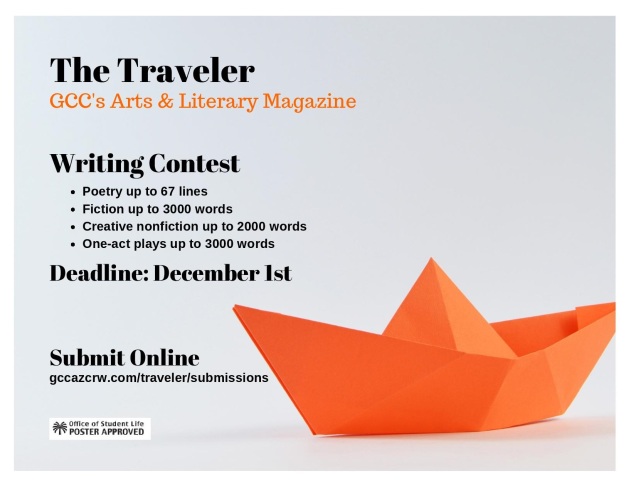
The Traveler, GCC’s Arts & Literary Magazine, is now open for submissions! We accept original works of fiction, poetry, creative nonfiction, and drama from registered GCC students. To submit, head here: Submissions Page.

Author: gccazcrw
Writerly Advice: Death by 1000 Cuts
Most serious writers learn from experience why revision and editing has to be an important part of the writing process. So many of us have had the experience of working arduously to create a specific image or character, only to learn after talking to a reader or a workshop that we haven’t succeeded in delivering our vision to the reader. Of course, this is one of the things that makes writing an art form: you can approach perfection, but you can never quite get there. You’re always striving to capture the elusive thing that’s in your mind because the words themselves are an imperfect medium for your idea.

But we try. And try. But how long do we keep trying before we call something done? Should we rework our poems, stories, and chapters endlessly until they see print somewhere, or is there some way to tell when we have made that piece of writing the closest, clearest approximation of our vision so that we can move on to other projects? The answer is, of course, different for different writers. I think most of us can agree, though, that if you’re not careful, you can edit something to death. You can poke at it so many times that eventually it just lays there on the pavement bleeding out of its myriad wounds.
I do not profess to have any concrete answers here and would encourage you to approach those who claim they do with skepticism. I can, however, tell you from personal experience what doesn’t work: Revising constantly based on different feedback from different readers.
I don’t know what the magic number is, but I do believe there is finite number of times you can workshop something before it loses its vitality, that original vision that drove you to write it in the first place. Revision should be about helping you achieve your unique vision, not trying to please everyone. The feedback you receive is a means to reach your own goals with the work, not an end in itself.
Inundating one reader with multiple drafts that have minor changes. Revision means adding or deleting scenes and potentially reorganizing the structure of your story, poem, chapter, etc. It does not mean changing a word from “desk” to “credenza.” (That’s editing.) It’s a beautiful thing to have someone who is willing to read your work. Don’t abuse them by offering too many drafts. Just like you, after the third or fourth time they look at it, things start to glaze over.
Spending too long on one project. One of the most exciting facets of any artistic process is the knowledge that you have created something concrete others can experience and enjoy. If you never call the thing done, you’ve never finished that creative process. Bringing an idea to fruition does not always mean publication. You the creator have to grapple with your own artistic conscience to determine when something is finished.

Grapple is the operative word there. How do you know when it’s finished? Perhaps it’s a set number of drafts. (One is not enough and 1,000 is probably too many.) Perhaps it’s a deadline you’ve developed based on an upcoming contest or one that is driven by time constraints in your own life (trying to finish that novel before summer is over, for example.) Or maybe if you’re not sure, you just take a few days or weeks away from the draft entirely. When you return, if you find you have fresh ideas for revision, apply them. If you dread picking that piece of writing up again or if you’re distracted by something new you want to work on instead, it’s probably because the previous project is finished or very close to it.
So yes, prick at your draft. Accept that bloodletting is a part of any art form. But apply your red ink with restraint, and, in the end, know when to call something finished. That’s a beautiful thing.
Jeff Sanger received his MFA from the University of Pittsburgh and teaches English composition and creative writing at Glendale Community College. In October, he will be running a free Saturday Workshop: Where Does Your Story Happen? The workshop is free and open to the public.
Saturday Workshop: Where Does Your Story Happen?
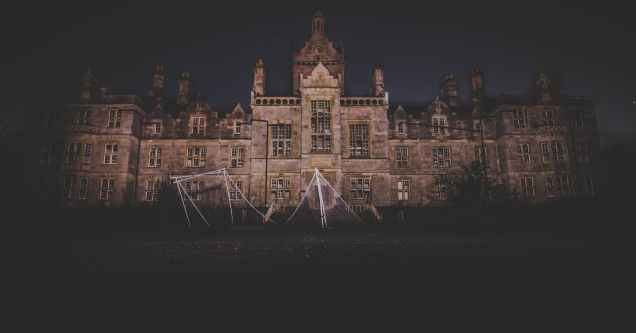
October. The moodiest of months. So dark. So brooding. With its long hair and Black Sabbath t-shirt. Its worn jeans and Judd Nelson tattoo that, with age, now looks like Al Pacino or wrinkled fruit or a wrinkled Al Pacino eating fruit. Welcome, October. Welcome the pop-up costume stores filled with glowing skeletons and child-sized Avengers and sexy iterations on mundane professions and forest critters and root vegetables. Embrace the candy, cast out the raisin-givers and the unprepared. Admire the faux spiderwebs spread across porches and balconies and tree-limbs. Visit, with perverse interest, the darker places of the world: graveyards, abandoned buildings, Walmart, and (you had to see this coming) GCC’s Main Campus on the morning of October 19th from 10AM to noon.
And why visit such a dark and dreary place as GCC on a Saturday? Because we’re having a writing workshop, of course. Our second of the year. Details below!

Whether you’re writing a memoir, a short story, or a novel, your story has a setting, a place where the events of the story happen. Your readers rely on you to provide some specific details about the setting so they can begin creating the scenes in their minds. But how much detail should you give? And where? And how might the answers to those questions depend on the kind of story you want to tell? Come to this workshop to discuss these and other important questions about your story’s setting.
Saturday workshops are free and open to the public. Water will be providing–begrudgingly. Also, maybe, treats.

- What: Where does your story happen? with Jeff Sanger
- When: Saturday, October 19th from 10AM to 12PM
- Where: GCC Main Campus, Room LA-141
- Why: Everyone is entitled to one good
scarewriting workshop in October
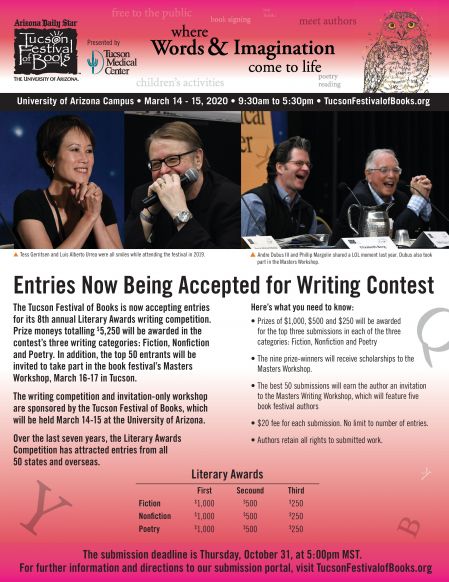
Tucson Festival of Books
While we here at GCC and in Maricopa have our own writing contests, we’d be remiss not to draw your attention to the numerous other opportunities you have elsewhere. One of these contests is hosted within our very state at the Tucson Festival of Books, and the deadline looms. Here are some details:

Saturday Workshop: Writing Vivid Villains
Hello. Is it us you’re looking for? Good. Good. Despite rumors to the contrary, the operators of this site are neither dead nor sacked, and they are (in fact) planning your doom a brand new series of Saturday Workshops and content posts for the 2019-2020 academic year. The first of those Saturday Workshops is just around the proverbial corner–assuming that corner is September 21st. Do you see it? Lurking. Waiting (a little too impatiently for our tastes, mind you). Standing outside your window with an (obviously) Bluetooth-capable Bose speaker over its head, blasting [insert modern-day romantic music here] like that one guy did in that movie long, long ago. He even wore a trench coat. It was pretty sweet. Do you know what else is sweet? Transitions.

In the first Saturday workshop of the new academic year, we will discuss what traits make a complex and compelling villain. Attendees will evaluate villains in film and literature and examine the often complicated relationship between antagonist and protagonist while using writing strategies to create their own caustic characters. Everyone leaves with a bad guy!
Saturday workshops are free and open to the public. Sometimes, water bottles and store-bought pastries spontaneously generate right there in the room.
- What: Writing Vivid Villains with Jayme Cook
- When: Saturday, September 21st from 10AM to 12PM
- Where: GCC Main Campus, Room LA-141
- Why:
Give us your heartAttend the workshop.We’ll give you a penWe’ll help you craft a villain.
Reminder! Saturday Workshop: Poem in Your Pocket
April is national poetry month, and this Saturday morning workshop will celebrate poetry! Poem in Your Pocket Day is part of the National Poetry month celebration, and we are going to celebrate this day at GCC. Come to this workshop with a poem in your pocket–or in your purse, your backpack, your hand. However you bring it doesn’t really matter, but choose a poem that can fit on one page. It can be a poem that you or someone else has written. Our task will be to analyze the short poem–the pocket-length poem–to see how it works. What techniques do poets use to impact the reader in a short space? We will explore the answers to this question and try a few techniques of our own.
All of our Saturday Workshops are free and open to the public.
- What: Poem in Your Pocket Day, facilitated by Kimberly Williams
- When: Saturday, April 6th from 10AM to 12PM
- Where: GCC Main Campus, LA-141
- Why: Because it’s our final workshop for Spring!
Reminder: Be Funny, Make Money (March 6th)
We are just a few days away from our Humorous Poetry Contest and our celebratory reading for the 2018-2019 Traveler winners. A few of our literary winners from this year’s Traveler will lead off the night, sharing their winning work. Afterwards, participants in the Humorous Poetry Contest will read/perform their funniest, most creative poetry, making us laugh and smile and snort.
Come to compete, come to listen, come to support this great opportunity for the GCC writing community!
- What: Humorous Poetry Contest (The Randy Smith Award for Humorous Poetry)
- When: Wednesday, March 6th from 7 to 9PM
- Where: GCC Main Campus, in SU-104 (A, B, C)
- Why: First place wins $100
This event is free and open to the public, but contest participants must be GCC students. We do not restrict the subjects of creative works.
Saturday Workshop: What Do Your Characters Want?
What do your characters want? What do they really want? What pushes them through their narratives? What are the motives for the crazy shenanigans that they get themselves into? What are the motivations behind their motivations?
Our characters may not know the answers to these questions, but we should. In fact, if we want them to be believable and relatable we have to know them and understand them better than they know and understand themselves. Let’s pick apart some fictional personas together so that we can try and understand what makes them tick—and in the process, try to learn what makes our own characters tick.
Saturday workshops are free and open to the public. Often, low-cost, yet impressive pastries will be provided.
- What: What Do Your Characters Want? with David Martinez
- When: Saturday, March 2nd from 10AM to 12PM
- Where: GCC Main Campus, Room LA-141
- Why: Did you see the line about low-cost pastries?

Traveler Winners for 2018-2019
It is with great pleasure that we announce the literary selections for the 2018-2019 issue of Traveler, GCC’s Arts & Literary Magazine. From roughly 100 submissions, the following pieces have been selected for publication:
Creative Nonfiction
- First Place: Charlie Bickel for “Creosote”
- Second Place: Jordan Johnson for “Free Tea Day”
- Third Place: Persephone Pilibossian for “The Price of Fitness”
Fiction
- First Place: Malka Daskal for “Princes in All the Earth”
- Second Place: Mindee Bahr for “Without Child”
- Third Place: Raushan Mateen for “The Library of Peace”
- Honorable Mention: Dawn Gibbs for “Hatching Day”
- Honorable Mention: Lynne MacVean for “Memorette Gum”
Poetry
- First Place: Persephone Pilibossian for “Reaching”
- Second Place: Persephone Pilibossian for “What is Due”
- Third Place: Jordan Johnson for “Mile Marker Eleven”
- Honorable Mention: Cynthia Herda for “Got Faith?”
- Honorable Mention: Cynthia Herda for “Imagine the Wind”
Our student staff, judges, and coordinator would like to express what an honor it has been to read all of the submissions. For those that were not selected for publication this time, please know that we value the opportunity to review your work, and we hope you will submit again for our next issue. Submissions will open up once more in Fall 2019.
We hope everyone joins Traveler staff and our literary selections for a celebratory reading on March 6th, from 7 to 9PM in SU-104 (GCC Main). Our student writers will read from their winning work. Also that night we will be holding a competition for our Randy Smith Award in Humorous Poetry (read more about that here). Between our Traveler readers and our humorous poetry competitors, we hope to have a fun and rewarding celebration of the creativity here at Glendale Community College.
The 2018-2019 issue will be available in print later this Spring. Thank you to all who submitted, and congratulations, once more, to our winners.
Scholarship: The Randy Smith Award for Humorous Poetry