Saturday Workshop: How to Write a Sexy Sentence

If you don’t think that the way an adjective pairs perfectly with a noun is erotic, then you have a thing or two to learn…

This workshop focuses on developing prose, word by word, sentence by sentence, with agonizing attention to detail. Whether fiction, non-fiction, poetry, or lyrics, at the foundation of nearly any exquisite piece of writing is a grammatically sexy sentence in which every piece of it works together harmoniously to perfectly express its meaning.

Semi-colon or period? What associations does this word carry with it to the page? What is a synonym for synonym? These questions and more will be explored during our workshop as we discuss diction, connotation, denotation, punctuation, and other –tions while we practice crafting the most perfect, most fluid, sexiest sentences we’ve ever seen.

heartbook

This workshop is free and open to the public. Breakfast-y refreshments will be provided, but bring your own caffeine!

  • What & Who: “Syntax: How to Write a Sexy Sentence” will be conducted by Jayme Cook.
  • When: Saturday, March 25th from 9:30AM to 11:30AM.
  • Where: GCC Main Campus, LA-141
  • Why: Because sex sells.

Saturday Workshop – The Role of Truth in Nonfiction, Fiction, & Autobiographical Fiction

For the Spring semester of 2017, we will again continue our Saturday Workshop Series. The first of our Saturday Workshops is nearly here, and we are pleased to welcome a new presenter: David Martinez.

cup-of-tea-book-table-reading-159788

Explore the space between nonfiction and fiction through writing from your core, and discover truth. Writing is hard for a myriad of reasons, and one of the most trying and difficult aspects for many people is finding that space that makes the writing (whether fiction or nonfiction) ring true. Join us as we sift through writings and methods that may help us grab hold of that ever-questioned, ever-scrutinized truth.

  • What & Who: “The Role of Truth in Nonfiction, Fiction, & Autobiographical Fiction” will be conducted by David Martinez.
  • When: Saturday, February 11th from 9:30AM to 11:30AM.
  • Where: GCC Main Campus, LA-141
  • Why: Because if you don’t, your friends and family will think less of you.

Saturday Workshop – Characterization: Populating Your Fictional World with Realistic People

Missed the workshop and want to see some of what Mark had to offer? Attended the workshop, but want to refresh your memory on some of Mark’s book selections and concepts? Head over to Workshop Materials and peruse the content covered in the workshop.


Have you ever read a book, watched a show, or sat through a movie and thought any of the following?

  • “Who does that? Real people don’t act like this!”
  • “I can’t keep track of these people. What’s his name is with what’s her face? Who’s that guy?”
  • “All of these characters could die in a fiery plane crash and I wouldn’t care.”

The fictional world may be fascinating, the conflicts may be intense, and the writing may be beautiful, but without fully realized characters to follow and root for, the story is ultimately doomed. Don’t fret, however. You can build unique and complex characters! Moreover, you can create characters with their own drive and will so that they surprise even you, the writer. Come join us or a free workshop to help breathe life into characters you will want to save from a plane crash.

black-and-white-man-person-cigarette
  • What & Who: “Characterization: Populating Your Fictional World with Realistic People” will be conducted by Mark Broeske, GCC Creative Writing faculty.
  • When: Saturday, November 5 from 9:30 to 11:30AM.
  • Where: GCC Main Campus, LA-141.
  • Why: Did we mention it’s free?

Saturday Workshop: Narrative Poetry

book-pages-med11

When is a story a poem?

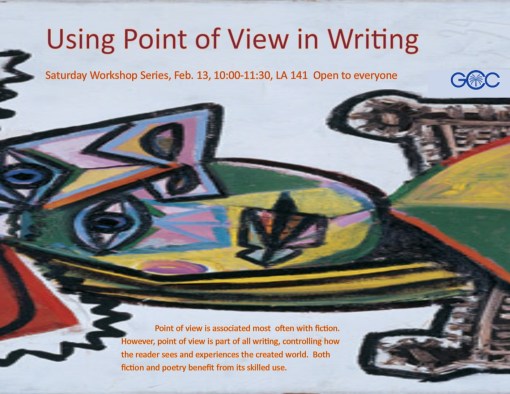
Spend a morning in the company of other writers discussing narrative poetry. We’ll talk about when and why to use poetic form to convey narrative. We’ll also discuss point of view within narrative and the differences point of view can make in a poem. This workshop, as with all workshops, is free and open to the public.

Saturday Workshop: Dancing in the Dark…

patrick-swayze-dirty-dancing-1987-photo-fc

There’s this scene you’ve been working on: Jack walks into a room. Diane’s already there. She’s drinking a mimosa and reading a travel guide for a place you haven’t decided on yet–maybe Barbados, maybe Detroit. Jack crosses the room. He tries to sit with her, but you forgot to include a chair, so he’s now hovering in an improvised yoga pose. Diane’s not even at a table, so when she releases the mimosa, it falls to the floor and shatters. This confuses the library staff because you’re not allowed to have mimosas in the library. Jack doesn’t even like to read, so he’s surprised to find himself in a library. He says, “When did I get to a library?” This echoes in the endless expanse of the void. When a librarian tells Diane about the no-mimosa rule, Diane says, “No dessert for me, thanks,” and then asks for the check. You suddenly remember that they’re at a tiki bar, but now the librarian feels overdressed. When the librarian tries to return to the Library Call Center, he trips over a bear rug on the floor and falls into a big pit—you know, like the one from the movie 300. Jack tries to reach out and help him, but the librarian seems miles away now. Diane leaves a tip on the floor and escapes, somehow, but you don’t remember there being any doors in the room. Maybe she climbs out a window or a skylight. Jack cries, lives the rest of his life alone, gets eaten by a lion floating in the void.

Sound familiar? No? Read more. It’s good for you, puts hair on your chest. Regardless, the point (there is one) is that place is often an underdeveloped and untapped resource in scene development. Where a conversation takes place can have just as much an impact on a scene as what your characters say. How your characters move, position themselves within that space, negotiate obstacles (bear rugs, bottomless pits, lions, etc.) can also flesh out the scene and present a more dynamic and engaging narrative. The Dancing in the Dark workshop will explore and discuss these concepts, Patrick Swayze, whether or not you can (in fact) put Baby in a corner, and The Boss.

  • What & Who: “Dancing in the Dark: Using Place & Choreography in Scene Development” will be conducted by Jeff Baker, English Faculty at GCC.
  • When: Saturday, September 10th from 9:30 to 11:30AM.
  • Where: GCC Main Campus, LA-141.
  • Why: Why not, tough guy?

This will be the first Saturday Workshop of the academic year, so we hope to see bright, happy, creative faces before Finals and The Nothing consume Fantasia, making everybody sad.

Mark Your Calendars: Fall GCC Events!

During Fall 2016, we will continue to support Free Association readings at GCC and hold free community workshops one Saturday per month. We hope to see big, happy, creative crowds at all of these events. Listed below you’ll find the current dates for our readings and workshops. We will have more details about each of these events as the calendar lurches closer to them. We will also look to add other events, both college- and community-run, when we are able. For now, mark your calendars and save the dates!

GCC Open Mic Events (GCC Main, SU104E)

  • Wednesday, September 21st from 7:00 to 9:30PM
  • Wednesday, October 19th from 7:00 to 9:30PM
  • Wednesday, November 16th from 7:00 to 9:30PM

GCC Saturday Workshops (GCC Main, LA141)

  • Saturday, September 10th from 9:30 to 11:30AM
  • Saturday, October 15th from 9:30 to 11:30AM
  • Saturday, November 5th from 9:30 to 11:30AM

Reminder: Out of the Bathtub Workshop is Tomorrow

0_0_0_0_387_290_csupload_23862753

So, you’ve built a character. You gave it cool clothes (turtle-neck, yoga pants) and a favorite whiskey (Wild Turkey) and deep, soulful eyes anyone could drown in (blue, naturally). You gave it a history too, filled with pain, regret, shame, and other abstractions. Oh, and maybe it used to fold clothes for Old Navy or bartend at that one Applebee’s–you remember, the one that nearly burned down because of poor deep-fryer maintenance. You gave your character a complex intellect and a deep appreciation for philosophical thought because, you know, that’s useful. But, see, now all the character does is wallow in a bathtub, breaking down the chemical structure of Pantene Pro-V and debating the authenticity of modern marketing’s practice of assigning gender to body washes and anti-aging cream. Who doesn’t want to feel the gentle caress of shea butter? Bask in the scent of champagne mango and white ginger?

Probably no one, but that’s beside the point. The point, if you’ve made it this far, is that narratives need characters that do things. In this workshop, we’ll dive into that further. We’ll talk about how terms like plot and conflict interconnect, discuss how you can affect the pace of a story by generating conflict in a variety of ways, and look at different strategies for injecting conflict into your narratives.

The Out of the Bathtub workshop will be conducted by Jeff Baker, one of the English Faculty at GCC.

  • When: Saturday, April 9th at 10:00AM (the workshop will run between 90 and 120 minutes)
  • Where: GCC Main Campus, LA-141
  • Why: Because Jeff Really Needs This

This will be the final Saturday Workshop for the Spring semester, so we hope to see you there. Bring your friends, your aunts and uncles, your neighbors, your fitness instructors, and any random people you meet on Saturday mornings.

Reminder! Saturday Workshop: He Said, She Said

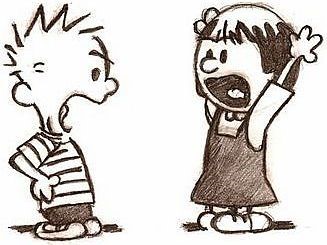
calvin1

What do your characters sound like? What would they say in situations you haven’t anticipated them encountering? The answer might surprise you. Come to the dialogue workshop and find out what your characters really want to say. Learn how cultivating each character’s unique voice can help you uncover hidden personality traits. Discuss examples of effective dialogue from various genres and explore how you can use dialogue to create compelling plot moves and authentic character development.

  • When: Saturday, March 5th from 10:00AM to Noon
  • Where: GCC Main Campus, LA-141
  • Why: Because We Said So

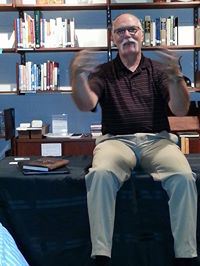
The He Said, She Said workshop will be conducted by Jeff Sanger. Jeff studied writing at the University of Pittsburgh, but learned what he knows about dialogue from his work in community mental health. His play “Crazy” was based on some of those experiences and produced for the stage as part of the 2011 Pittsburgh New Works Festival. His work has also been published by Akashic Books, The Compleat Mother, Mt. Lebanon Magazine, and Souf Oaklin’ Fo’ Life. When he’s not teaching English composition for GCC main and north campuses he enjoys playing Minecraft with his three children and cooking with his wife. He’s been married for over 14 years, proof he knows how to listen to what people say!

Saturday Workshop Series: When is a Novel NOT a Novel?

14 November 2015–When Is A Novel NOT a Novel?

When it’s a novel in short stories – that is to say, when it’s a short story sequence.

Gary Lawrence
Gary Lawrence

A short story sequence is two or more short stories that share at least one important narrative element – plot, setting, character, or theme. Short story sequences are not new; but they are experiencing a resurgence today as “novels in short stories.”

As “novels in short stories,” short story sequences are unique, because they blend the best attribute of a short story (its autonomy) with the best attribute of a novel (its unity). Imagine, if you will, a novel where every chapter stands both on its own AND as an integral part of the overall story arc. The sum is therefore often more than its parts. Louise Erdrich’s 1984 classic Love Medicine and Phil Klay’s Redeployment (2014 National Book Award winner) are two of many successful modern examples.

This workshop will define the short story sequence form; analyze a modern short story sequence written by the workshop leader; and give student writers time and guidance to explore this “sequencing” option in whatever they write: stories, novels, CNF, and/or poetry.

After a 30-year management career in the aerospace industry, Gary Lawrence now teaches composition and creative writing at GCC and Cochise College. His short stories have appeared in Short Story America print anthologies (Volumes II and III) and Four Chambers literary magazine (Volume I). He self-published his short story collection Baffled in 2013. He was also interviewed by NPR in 2014.

Gary has an MFA in Writing from Vermont College of Fine Arts and a BA in English fromRockford College. He is originally from Rockford IL and lives today in Sierra Vista AZ with his wife Linda and their Yorkie Poo Rocky.

Join our GCC CRW community for an inspiring and informative workshop on an aspect of creative writing. Topics this year include characterization and more!

The workshops are facilitated by our CRW faculty and talented community writers. These workshops are free and open to the public.